


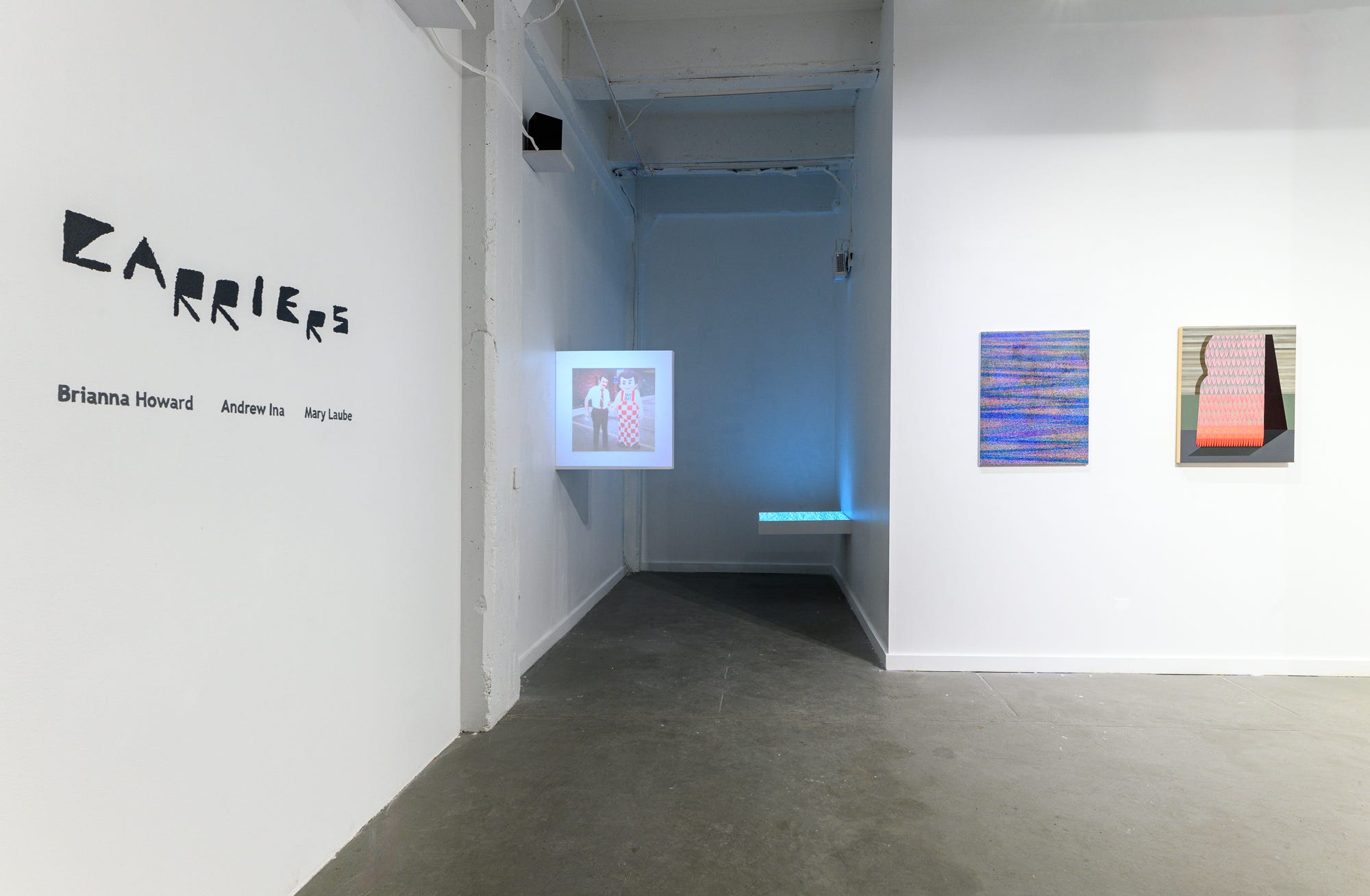
Carriers is an important show of the moment, specifically for its lack of resolve. An exhibition currently on view at Tiger Strikes Asteroid in Philadelphia, now through March 14, 2026, Carriers references and fragments, leaving the viewer in a balancing act attempting to measure the weight of stolen cultural memories and cultural displacement on the same plane as fragmented pixel resolution. I love the works of these three artists individually, but the curatorial choice to invite the three to share space led to deeper digging.
This group show, based on an open call, includes paintings by Mary Laube and Brianna Howard, and a 3-minute looped video installation by Andrew Ina. The title nods to someone or something that transports goods, people, and information. A carrier is a vessel, a medium, a body in transit. Organized around the fragmentation of personal and cultural memory, the works address the way things are lost, altered, and partially recovered in transmission across time and borders.
Ina’s installation, which includes personal archive images of family with found images, attempts the impossible by tracing memory and archives that do not exist in their completion. He does so with a consistent feeling of grief and loss. As a whole, Ina’s art practice interweaves found, autoethnographic, and archival materials to reflect on cross-generational survival within the SWANA diaspora. According to the SWANA Alliance website, SWANA is a decolonial word for the South West Asian/North African region in place of terms like Middle Eastern, Near Eastern, Arab World, or Islamic World.
Architected into the alcove of the gallery, Ina’s video installation includes a white panel protruding perpendicularly, hovering off the ground, like a window or a sign. Projected onto the square plane is an animated dance of cut-out photographs, a man posing with Bob’s Big Boy–a fixture of postwar American suburban life, a horse, a blurred map of the island country Cyprus,* a barren landscape. This mixed-media animation is astoundingly hypnotizing. I stare and stare, never really knowing fully what I’m seeing. Jutting behind is a tabletop-like panel with a video projection coming down from above that oscillates between water and pixels continuously. This serene screen forces the viewer to look down upon it, an unusual feeling when viewing art.
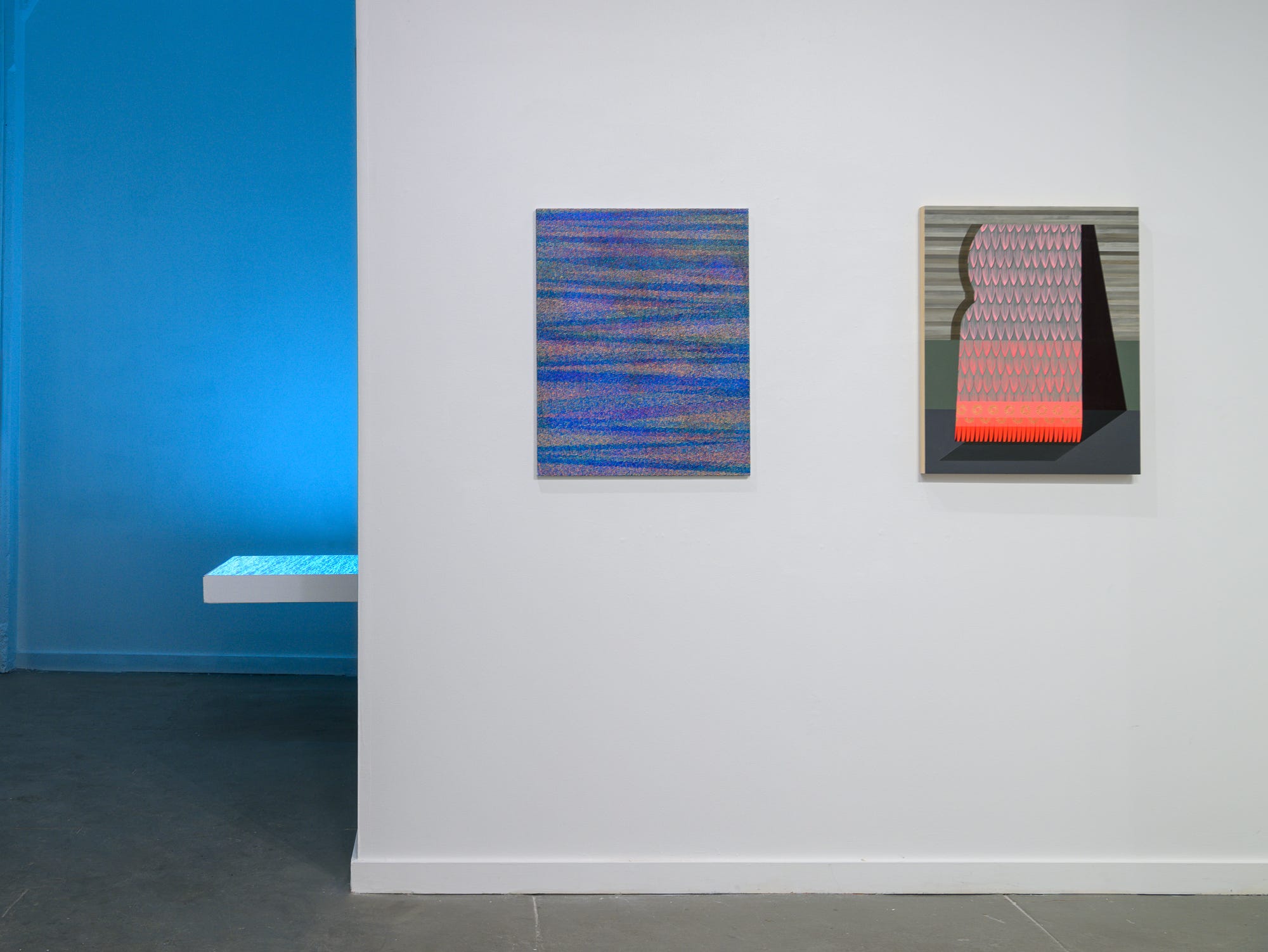
To the right of Ina’s work is a painting by Howard, Signals in Blue Distance. Immediately, a connection is made between Ina’s water reflection turned pixel with Howard’s way with paint that resonates like sound and pixel. Where Ina’s audio is a mix of ambient noises, water, and insect sounds that chirp in and out of frequency, Howard’s many, many dots accumulate like cells dividing, or like the manual labor of a beaver slowly, painstakingly building a dam. Howard’s analog layering is intuitive, like a flawless user interface. And Ina’s audio brings Howard and Laube’s paintings to life, as if they’re buzzing. It’s here where the conversation begins between Howard and Laube. Their paintings talk back and forth around the room, pushing and pulling the viewer through the show.
However, there’s a tension around the curatorial decision to include Howard’s work in this show. Artworks based on lost cultural memory are the kinds of works, particularly Ina’s, that are grieving in a way. I worry that there might be a contested imbalance in weight across the types of fragmentation we are discussing in Carriers. In Seph Rodney’s 2021 Hyperallergic essay, “On Grieving and Mourning with Art,” he wrestles with a similar tension as he compares two very different shows that portray Black grief. Rodney questioned the authenticity of the grief in works like Rashid Johnson’s “Antoine’s Organ” presented in Grief and Grievance: Art and Mourning in America at the New Museum, to “a kind of emotional earnestness” in a much smaller, less star-studded show, On Protest and Mourning mounted online by the Caribbean Cultural Center African Diaspora Institute (CCCADI). I wondered if Howard’s paintings about a more abstract fragmentation might dilute the heft and theft of loss in both Ina and Laube’s pieces.
I’m not mad Howard is included, just curious. After recently seeing footage on social media of an air strike on Tehran’s telecommunication site, a bright blue flash of light exploding–different than the grey, black, red explosion of buildings–I think of Howard’s paintings. When I saw this video–a video I cannot retrace when re-scrolling through my feed history–it was then that I surrendered to the tensions this show holds. Howard’s work has a continuity across all paintings that reads simultaneously as TV static, a photo too zoomed in becoming pixels, and maybe even an electrical explosion. But it’s paint.
In a Post-Internet society where our lives are as much, or more so, online than in the physical world, what happens if all of that disappears, as it can in war zones? In the weeks since Carriers opened, the U.S. and Israel began conducting their joint attack on Iran. And Iran is SWANA. Already, there’s been major damage to cultural landmarks like The Golestan Palace. When telecommunication is wiped out by weapons of destruction, how does one communicate? The war never leaves my mind as I meditate on the work in this show.
Hope is the Thing with Feathers, the painting by Laube to the right of Signals in Blue Distance, is the title of one of Emily Dickinson’s most famous poems. It’s a poem I’ve carried with me for many years now, having received a card with the poem on the cover. I pin it to the corkboard above my desk and look at it when I need to stare into space. Dickinson’s work’s hauntingly personal voice resounds despite having only published about 10 out of 1,800 poems while she was alive. If you peek even a little bit into the dispute around what Dickinson’s wishes were for how the works should be published, you can see the parallel here in Carriers. Not unlike the fragmented and edited histories of the SWANA diaspora, Dickinson’s poems were published and edited in varying ways, sparking debate over her true intentions.
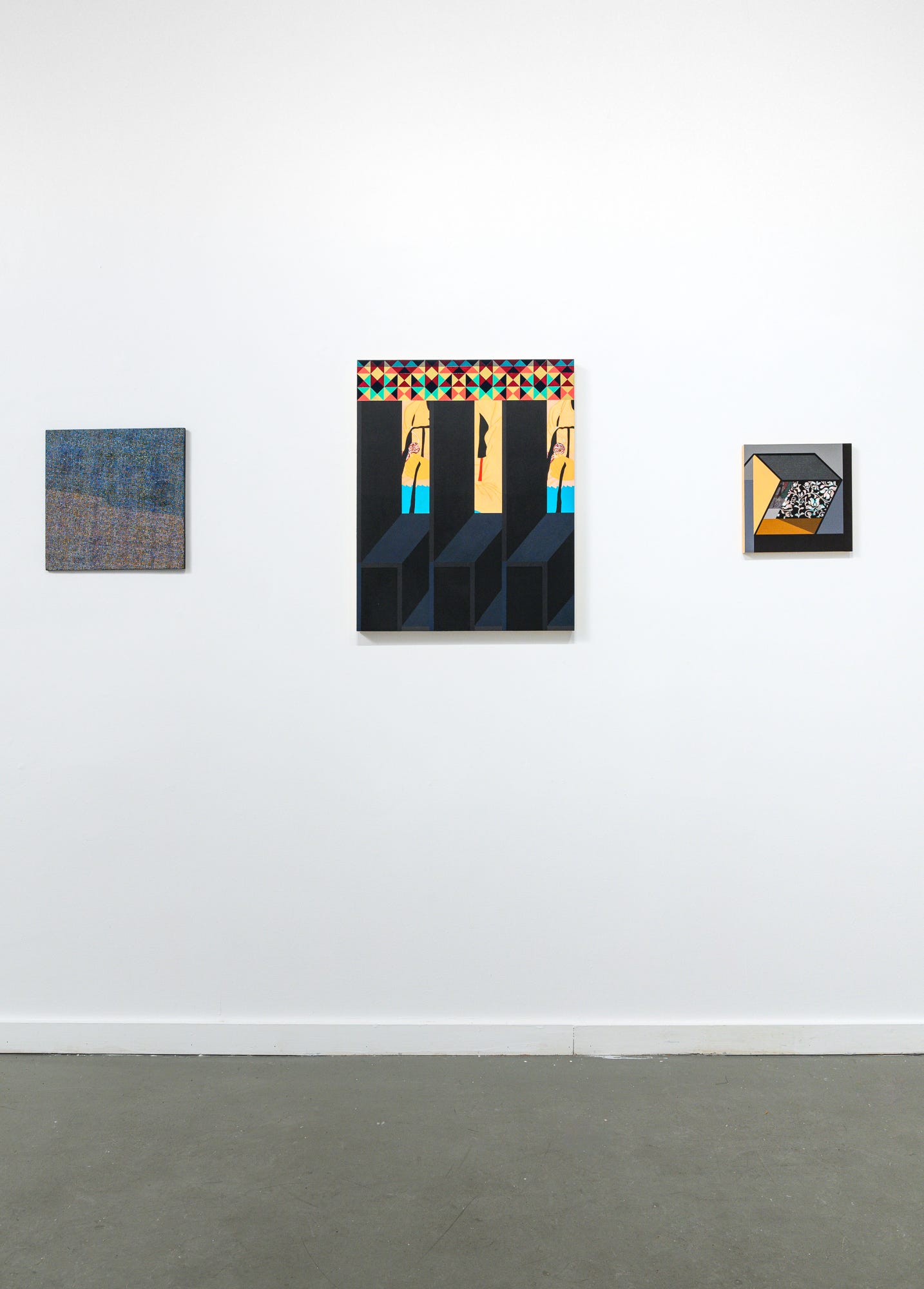
And still I wonder about Laube’s use of a Euro-American poet within her work, as an artist born in South Korea, currently based in the U.S., whose work is a bold reclamation of agency and privacy. It seems she, too, is welcoming this tension I felt earlier. Looking into Laube’s exhibition history, I was struck by the exhibition text for a Korean American Artist Collective group show titled BULLPEN, which states,
“Curating a show on the basis of identity requires an understanding of what it is—and to define it, is to confine it. Here we come across the first landmine (representation is a dangerous business so it’s useful to have a trusty, mine-sniffing rat by your side). When you are born othered, you have no choice but to define yourself with, or against, the language of the oppressor.”
Rather than constricting identity, Carriers remains broad. It’s this very entanglement that is our complex world, which makes Carriers both potent, dangerous, and precarious. And preservation is a precarious kind of truth-telling. This work by Laube is the only one of hers within the show that has no figurative element: no hand, eye, or hair. It frustrates. I stood before it, frustrated by its confident abstraction, until I realized Laube’s power over me. This is her exact point. I’m not allowed to see her unless she lets me in. Which she generously does. And the viewer’s body becomes a kind of carrier as it floats through the show, subconsciously receiving the message it needs from each work. Like the fragility of a messenger pigeon flying from point A to point B, I view the remainder of the works. Once a very analog way to communicate, a homing pigeon could become the most secure mode of communication in a society of mass government surveillance and capital warfare.
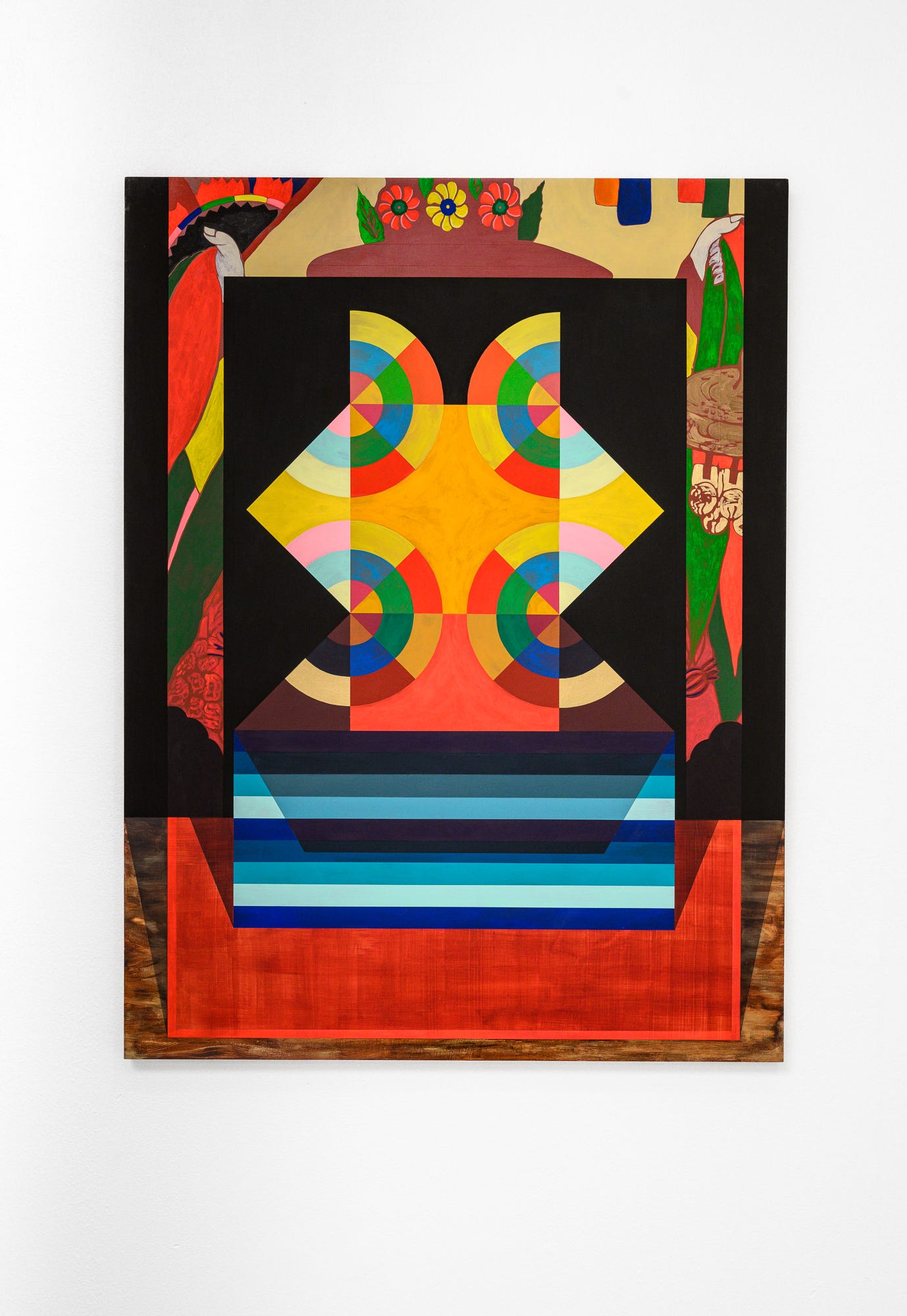
Is erasure, erasure, regardless of individual or ethnic cultural pain? Dickinson’s insertion in the show provokes this question. There is power and agency in self-protection and the refusal to be simplified or confined. I’d been questioning the curatorial decision of including Howard in a show with two artists whose work wrestles with cultural visibility and memory, but these Dickinson poems allow me to finally see a through line. Laube’s work pushes and pulls the viewer simultaneously. It’s about the friction we feel when we can’t know. The choice to remain mysterious and not unveil oneself is agency. Her colors are equally alluring and opaque, both a window and a wall.
A Sweeter Rose a Softer Sky reads like a desperate wish for a freer, more peaceful world. It becomes her own kind of Renaissance altarpiece. Taking the structure of Western devotional authority, Laube puts something else in the center. And Tibetan thangkas and Buddhist mandalas are also inserted, yet collapsed. This work is doing what Laube states she wants to do in her work: reconfigure objects from different national, political, and religious traditions into synthesized forms that become flattened, off-kilter, and unnamable. A figure’s hair is ornately decorated in flowers, and hands pull back a curtain to reveal a rectangular block of colors: no face, no figure, no identity. Laube will not be anyone’s puppet; she is her own master in these painted worlds.
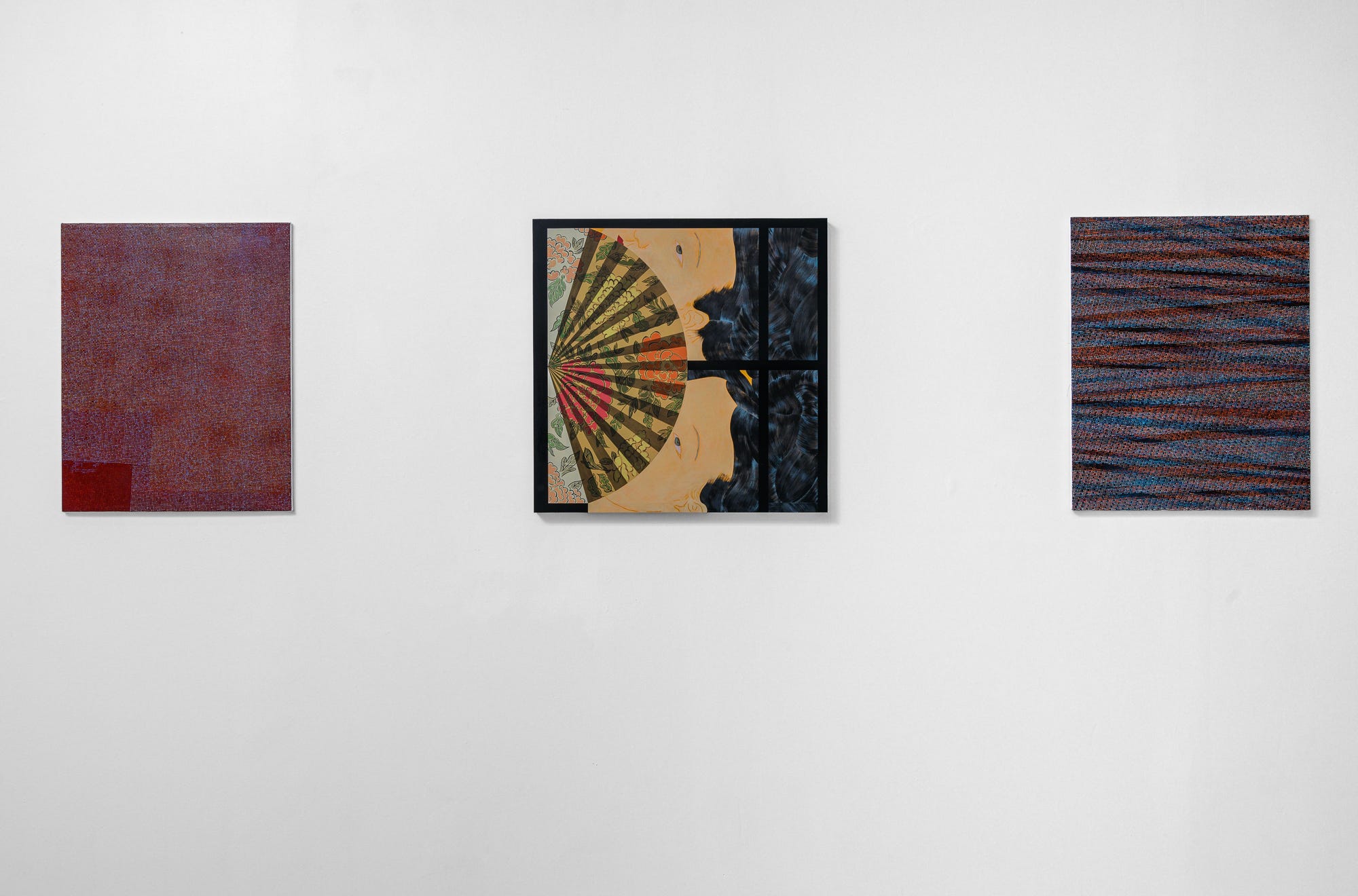
Faded Blossoms Fresh When Worn becomes Laube’s most vulnerable work. It’s the most revealing; the figure is almost glaring, and not at us, but past us. Eyes, tightly manicured brow, lush, black, blue hair combed, and a fan, creating an imagined breeze, the blow of a resolute spirit. This blue in the hair is the same in Ina’s projection. It’s the same blue I saw online–the electrical explosion–the many tiny dots in Howard’s works; it’s fragmented throughout. This blue is ocean that divides, separates, sometimes protects, sometimes drowns, and also carries. It’s blue–the computer screen–binary discourse that only serves to further fragment. It’s a blue sky, sadness, the air we share, the way the bird moves, carrying the message in both song and letter. It’s in the ink of a pen quill tracing the past from beginning to end.
*Andrew Ina later tells me that the map of Cyprus depicted was a map of the proposed 1919 colonial mandates by the United States, following the Balfour Declaration. It shows modern day Lebanon falling under French control.