


Space On Space: You’ve been working at the Arthur Ross Gallery for several years now. In 2022, you began as Assistant Director, and two years ago transitioned to Director of Exhibitions and Curatorial Affairs. How has the programming shifted since you joined during the pandemic?
Emily Zimmerman: When I arrived in 2022, the Arthur Ross Gallery had a mission that was anchored in the University of Pennsylvania’s academic mission in the arts, highlighting artistic research at Penn, the University’s collections, and curatorial seminars, but the gallery also presented the work of national and international artists, collections, and traveling exhibitions beyond the University. From 2022-2024, I realized two exhibitions, Songs for Ritual and Remembrance, and Barbara Earl Thomas: The Illuminated Body, for which the Arthur Ross Gallery received its first Pew grant of $240,500.
In 2024, the mission was refocused to serve the academic mission in the arts more purposefully. That new mission has meant welcoming our inaugural Faculty Director, Dr. Gwendolyn DuBois Shaw, who curated our current exhibition, At Liberty: Life in the City of Brotherly Love During the Early Republic. At the same time, my work shifted to focus on curating the Weitzman Fine Arts MFA thesis exhibition, which I did in 2025 and 2026.
This series of commissions in dialogue with the Fisher Fine Arts Library is one that I have been dreaming up with my co-curator Cole Akers for the past two years. It is a joy to see the first project with Ralph Lemon come to fruition.
SOS: What sparked this project with Ralph Lemon concerning the Fisher Fine Arts Library and Frank Furness’s architecture?
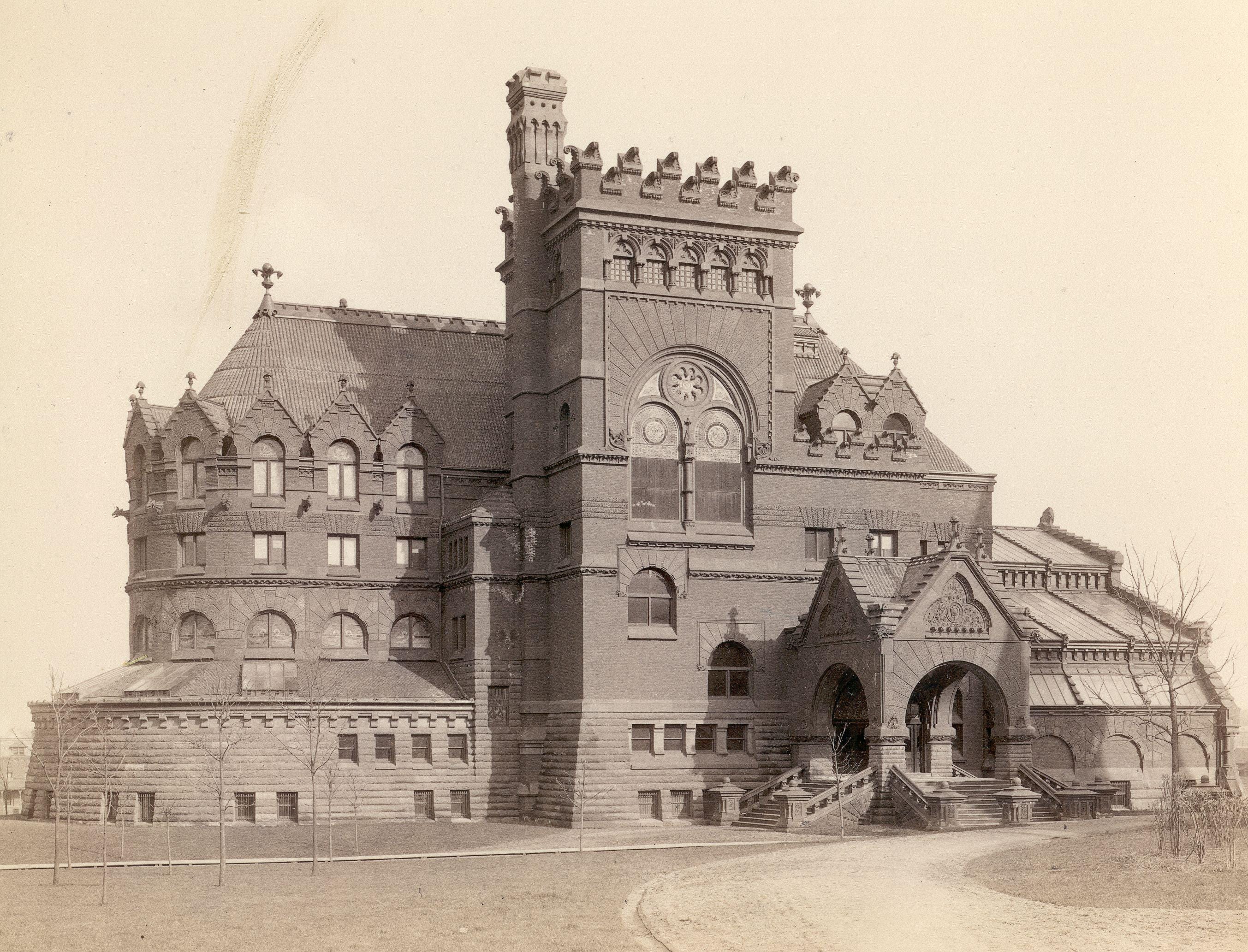
EZ: This initiative began from a shared enthusiasm between Cole Akers and me for the Fisher Fine Arts Library itself. The building has an incredible history. Furness’s library for the University of Pennsylvania was dedicated in 1891, and its history since then has been anything but static. The building received additions in 1916, 1922, and 1931, survived a near-demolition, was designated a National Historic Landmark in 1985, and was restored between 1986 and 1991 by Venturi, Scott Brown and Associates. A major façade restoration is wrapping up this fall. That storied history is recounted in Forever Furness, the gallery’s audio tour of the library on Bloomberg Connects, which I recorded with William Whitaker of the Architectural Archives and Mia D’Avanza, the library’s director. It was while working on that tour, and in the Arthur Ross Gallery’s own archives, that I came across the original Forever Furness campaign, which contained the seeds of the idea of a commissioning series in dialogue with the building.
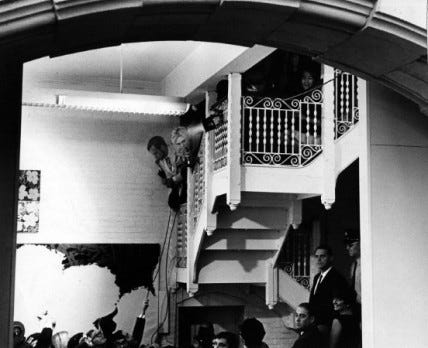
It has also been a home for the arts at Penn since it opened: it was the first home of the Penn Museum in the 1890s and later housed the Institute of Contemporary Art, and there is a well-known photograph of Andy Warhol on its staircase at his 1965 ICA opening. As the library completes its restoration, we wanted to invite artists from a range of disciplines to help us see it anew.
The series was conceived as multidisciplinary from the start. Cole Akers and I knew early on that the commissions could not be limited to the visual arts, and that dance and music had to be part of it. I have long been drawn to the way choreographers think about embodied space and the built environment. I spent the first seven years of my career at the Experimental Media and Performing Arts Center at Rensselaer, and that is where I first met Ralph Lemon in 2013. He was working on a piece called 4 Walls, and it was exactly the kind of interrogation of space we were looking for here. When Cole and I started listing artists to invite for the series, Ralph was at the top of my list.
SOS: How does a working research library function differently from a museum or a performance space when serving as a site for commissioned work?
EZ: This series of commissions is entirely site-specific, which is one of my favorite ways of working. For these commissions, it will mean collaborating with the building–what it will allow and not allow–at times embracing what it has to say and at times pushing back. I remember at one point Ralph said that the building was “very loud,” not meaning acoustically loud, but that its architecture has a lot to say. There are always architectural constraints that one has to navigate when working in a site-specific way.
SOS: Are there particular histories or stories that have emerged through Ralph’s research that you didn’t expect to find? What is in the shadows that you are hoping to make visible through this process?
One of the early finds was the address “The Memory of Man” by Talcott Williams that was given at a ceremony where the cornerstone of the building was laid. The sentence construction in it had such a profound sense of gravity. Talcott Williams was an American journalist who worked for thirty years with The Philadelphia Press and donated a large collection of Moroccan pottery to the Penn Museum.
No spoilers, but I will say that the research involved the balls that were thrown around the years following the Furness Library opened (Penn had a strong culture of balls that included the Ivy Ball, the Henley Ball, and many others).
SOS: How was the residency structured?
EZ: The residency, which is supported by the David Evans Family Artist Residency, Weitzman School of Design’s Department of Fine Arts, and its new Penn Performance Studio, had two strands: research visits to sites and archives, and extended time to write in the Fisher Fine Arts Library itself. The research began with William Whitaker, Curator & Collection Manager at Penn’s Architectural Archives, which holds the Furness library archival material and was the natural starting point, and continued from there to the University Archives and Records Center. Over the summer, Ralph worked with Shaila Gray, the Arthur Ross Gallery’s Summer Humanities Intern, who took on the more specific questions he was putting to the archives and coordinated the visits. The writing happened in the library’s reading room, where Ralph drafted the lecture-performance.
SOS: What does the archival research across the Architectural Archives and the Penn Museum involve?
EZ: People often assume archival research is dull, and the reality is the opposite. It is closer to detective work. This research began with a simple question: what were the names of the people who built the Fisher Fine Arts Library? While Furness’s name is on the building, the names of the masons, ironworkers, carpenters, and laborers who raised it are not. The research into the individual lives of the workers who built the library sent us to the Architectural Archives, where William Whitaker pointed to the historic structure report that had been written when Venturi, Scott Brown and Associates undertook the renovation of the Furness Library. That report revealed the names of the companies like R. F. Bancroft and Son (cast ironwork), and W.R. Chapman (masonry and brickwork), but not the individuals who worked for those companies.
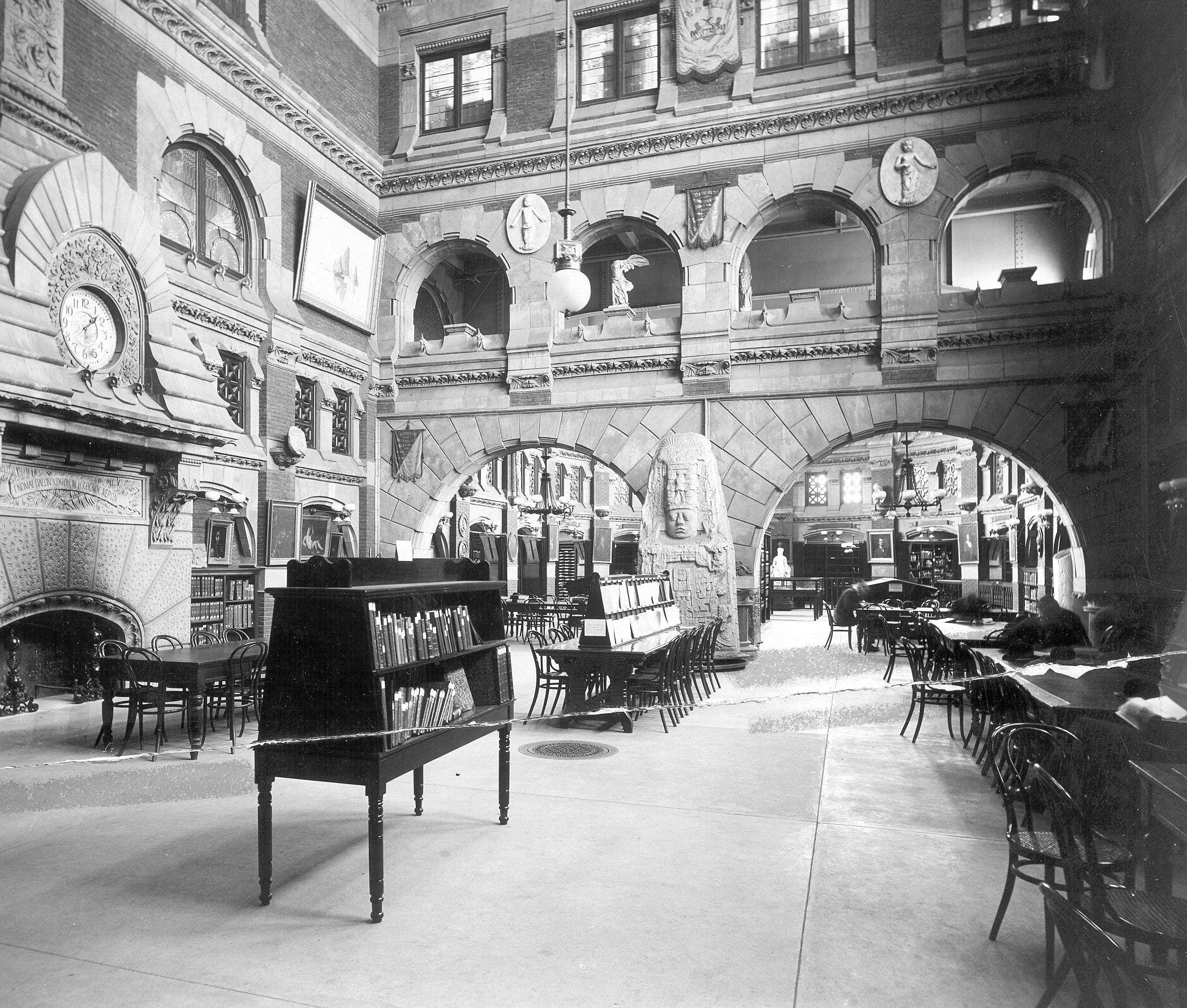
The focus of the research then turned to who was spending time in the Furness Library just after it was completed. The fourth floor of the building was originally meant to be the auditorium for the University of Pennsylvania. Prior to the building’s completion, the archaeological expeditions that were being undertaken by the University in the Middle East resulted in so many artifacts that, by the time the Furness library was completed, it was repurposed as display space for what would become the Penn Museum. The Furness library was the home for those artifacts for the first two years, and then in 1893, the University made the decision to build the Penn Museum because there was a statue that was too heavy for the floor of the Furness Library without additional structural support in the basement. The archives at the Penn Museum included a 1892 letter from Frank Furness to Sara Yorke Stevenson, Curator of the Egyptian and Mediterranean Sections, in which Furness described the structural issues. Soon thereafter, a petition to build a new museum building began.
SOS: How does the initiative unfold across dance, sound, and visual art?
EZ: The series of commissions will approach different ways of engaging with the building. Dance, sound, and visual art were chosen because each registers the building differently. Movement responds to the library as a body moves through it; sound responds to its acoustics and its silences (the Fisher Fine Arts Library is a silent space, and one of the library’s most visible windows announces “Talkers are no great doers”); visual art responds to its surfaces, materials, and powerful visual presence of the building. Each of the commissions is designed to be temporary, and to be sited somewhere inside the Fisher Fine Arts Library or its gardens. Ralph Lemon opens the series as the David Evans Family Artist-in-Residence, and he also serves as an adviser to the series as a whole. His lecture-performance on September 18, “The Fugitivity of Water,” will be its first public outcome. The sound and visual art commissions will follow, with the commissioned works entering development in fall 2027 and beyond.
SOS: Any other upcoming projects we should be aware of happening at the Arthur Ross Gallery?
EZ: There will be an exciting series of exhibitions at the Arthur Ross Gallery this winter and spring, including an exhibition with Wanda Raimundi-Ortiz that grows out of Vámonos pa’l monte, the artist’s Mural Arts Philadelphia commission, curated by Gwendolyn DuBois Shaw. In the spring, we present the 2027 MFA Thesis Exhibition, our annual partnership with the Department of Fine Arts at the Weitzman School of Design, and I will curate it again this year. Last year’s edition, Under Scores, included an evening of live performance, and the students’ work increasingly moves between media, which has resonance with the commissioning series in dialogue with the Fisher Fine Arts Library.
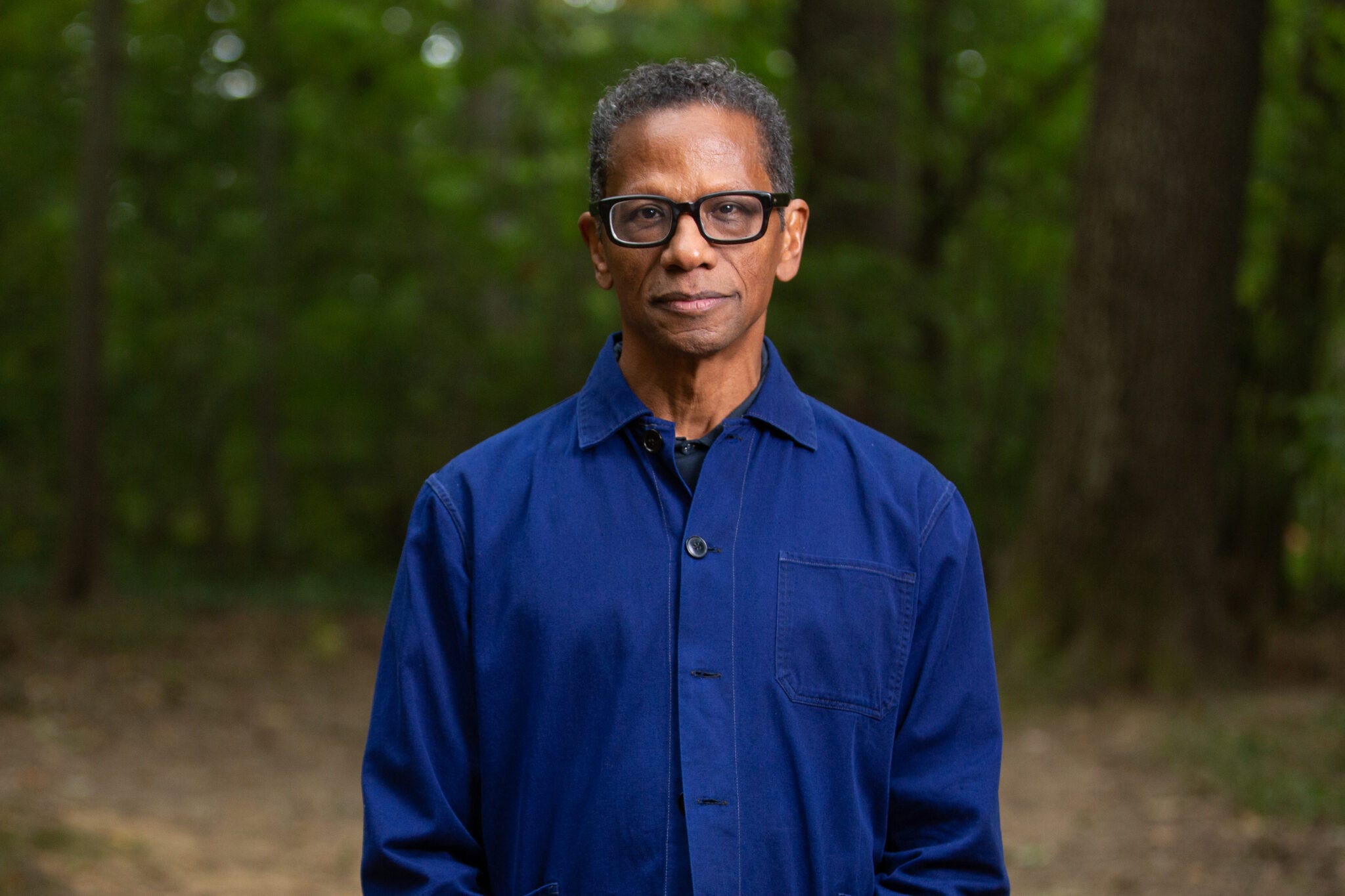
Ralph Lemon has spent more than four decades working across choreography, writing, drawing, and performance. He founded the Ralph Lemon Dance Company in 1985 and led it for a decade before turning to long-form, research-driven projects, a shift that reshaped his practice and helped redefine the terms of postmodern performance in New York. Since then, his work has moved fluidly between the stage, the museum, and the page, and it is held in public collections including the Studio Museum in Harlem, the Whitney Museum of American Art, The Museum of Modern Art, and the Walker Art Center, Minneapolis. He is currently a Visual Arts Mentor at Columbia University School of the Arts and has held fellowships and residencies at Yale, Stanford, Brown, Temple, Princeton, the Krannert Center at the University of Illinois, and the Museum of Modern Art. His honors include a 2020 MacArthur Fellowship, the 2022 Bucksbaum Award for his work in that year's Whitney Biennial, a 2024 Pew Fellowship in the Arts, a 2015 National Medal of Arts, a 2018 Heinz Family Foundation Award, a 2009 Guggenheim Fellowship, one of the first Doris Duke Performing Artist Awards (2012), and one of the first United States Artists Fellowships (2006).
Emily Zimmerman is a curator and arts leader with 20 years of experience in museum curation and arts education. She is the Director of Exhibitions and Curatorial Affairs at the Arthur Ross Gallery at the University of Pennsylvania, where she also teaches the Spiegel-Wilks Curatorial Seminar for the Department of the History of Art. From 2017 to 2022 she was Director and Curator of the Jacob Lawrence Gallery at the University of Washington, where she expanded commissions for under-represented artists through the Jacob Lawrence Legacy Residency and an annual curatorial fellowship for graduate students of color, and founded MONDAY, a W.A.G.E.-certified journal of experimental arts writing. She previously held curatorial positions at the Henry Art Gallery and EMPAC at Rensselaer. Over her career she has curated more than 50 commissions and exhibitions with artists including Pierre Huyghe, Jesper Just, Guadalupe Maravilla, Kerry Tribe, and Marisa Williamson, and has produced over 300 public programs. Her writing has appeared in BOMB and Contemporary Performance, and she has served on review panels for the National Endowment for the Arts, Creative Capital, and the New York State Council on the Arts, among others. She is a board member of Vox Populi and holds an MA from the Center for Curatorial Studies at Bard College and a BA from New York University.
Space On Space is a media movement started in 2020. Originally a cathartic impulse to process the times, SOS has evolved into an investigation into the connections between land, power, and art. The outlet creates content and offers PR services to help artists, designers, and businesses take up more space in the media. At the intersection of art writing and public relations, SOS interrogates the line between myth-making and the historical archive. The publication has produced print magazines and digital content covering artists from around the world. The magazine hosts parties, public programming, and poetry events. In a media landscape built for speed, SOS slows down—because depth is disruptive, and attention is power.