


“We’ve only just begun.” The phrase rings in my ears as I’ve been toiling over this essay for months now. I’m sitting in the ER with my daughter, who may have vomited blood. It’s 2 am. We’ve been here for hours. It’s a seemingly hopeful phrase, expressing optimism for the time still left and the paths one gets to choose. It’s the title of a song sung at countless weddings. Yet, beneath the surface of the phrase—and the song sung by the late Karen Carpenter—is an enduring painfulness.
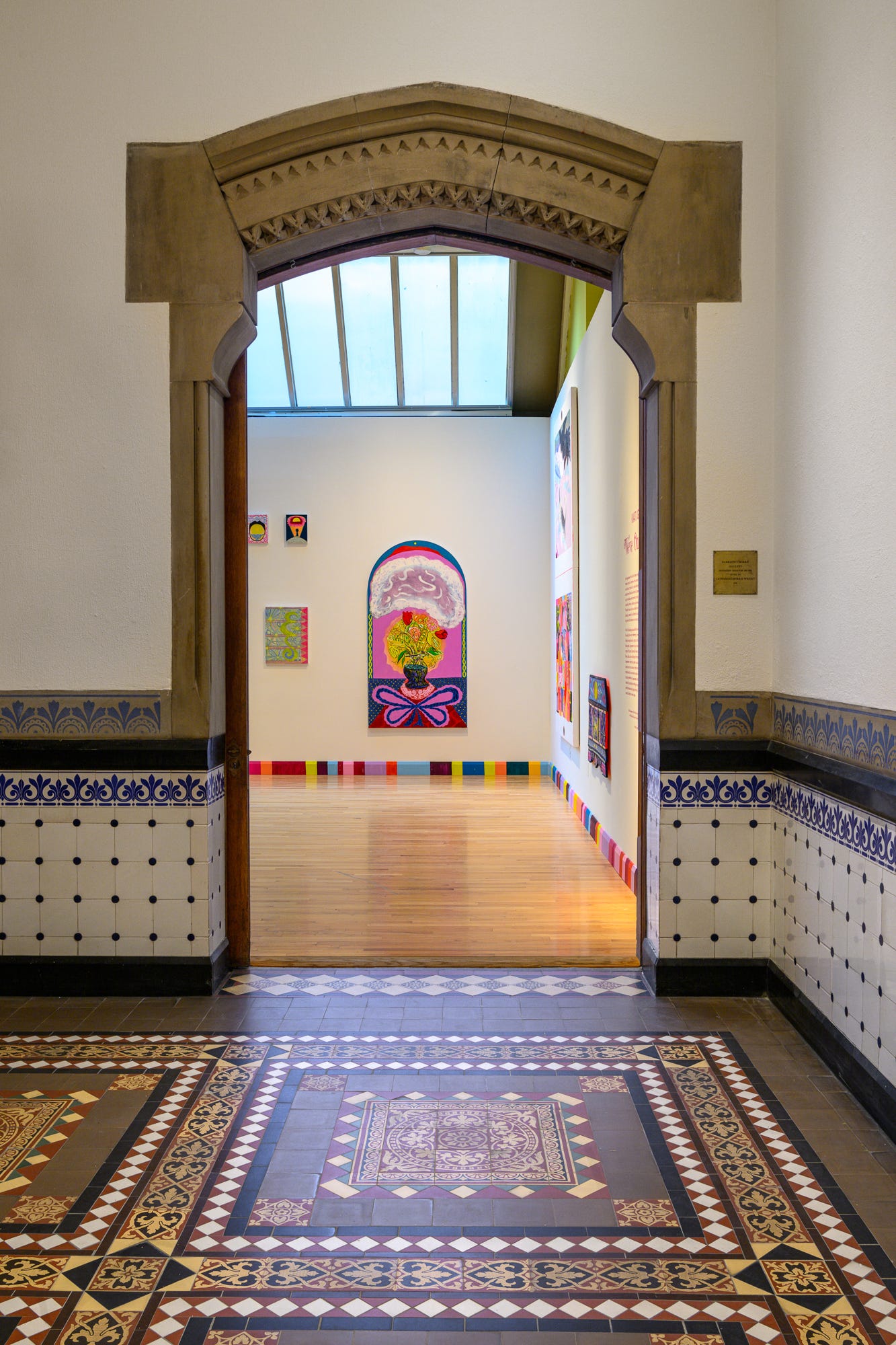
In Buddhist teachings, suffering is a central concept where practitioners are encouraged to remain with pain, despite it. And this painfulness and yet an ever-persistent hope—both courageous and naive—is a thing of introspection, a fascination of Kati Gegenheimer. Curated by Leah Triplett, Gegenheimer’s solo exhibition, We’ve Only Just Begun in the Morris Gallery at PAFA, is on view now through December 31, 2026.
There seems to be a link between suffering and love in these paintings.
When speaking with Triplett and Gegenheimer separately, they each described the creation of this show as an act of faith—not luck. I grew up listening to The Carpenters, particularly around Christmas time. What I remember most about them was not the music, but Karen Carpenter, the woman. She was beautiful. The media’s image of perfection. Any woman who grew up in the 90s knows this aesthetic specifically.
Thin, pale, pretty, polite, docile.
Karen rose to fame at an early age with her older brother. She was the lead vocalist and drummer. I, too, took up drum lessons as a child. I felt edgy about this choice of instrument, but too shy to really use the sticks the way they were meant to be used. I, too, was trained as a young girl to be quiet and good. Karen Carpenter tragically died at the age of 32 from heart failure associated with anorexia. This was at a time when there was little public discourse about eating disorders. In many ways, We’ve Only Just Begun, the song, expresses a promise of many more years; a promise Karen herself didn’t get. The song by The Carpenters is earnest, even if it’s ultimately heartbreaking. I notice my sadness and cynicism while facing such an earnest love song and such bright paintings.
My daughter is two. She is strong and a fighter. I am a worrier. We leave the hospital after many hours, and it appears that she just has a stomach bug. Her life is not ending. But now we’re all overtired, and I am embarrassed.
Back in April, I stared at Gegenheimer’s paintings for quite some time at the public soft opening of the exhibition and PAFA’s simultaneous opening of A Nation of Artists. One could read Gegenheimer’s paintings as girlish: bows, heart-shaped locks, still-life flower bouquets. To describe something or someone as “girlish” is a way of not taking them seriously. Girls aren’t taken seriously until they become women or married or educated or until they dress or look a certain way. Maybe once they are taller, they will be respected. Maybe if they wear heels or straighten their hair or lose weight. When does girlhood give way and the woman take flight? Who is allowed to remain a girl and for how long? Whose innocence is taken away too soon? When I meditate on Gegenheimer’s works—which they do require actual meditation—I see far beyond the girlish, happy colors. The imagery does something subconsciously along the lines of hope. There’s a political seriousness to the work that I urge viewers not to miss.
The reopening of the Morris Gallery in 2026 itself is an act of resurrection. Originally founded in 1978, it was established to exhibit contemporary work by living artists with ties to Philadelphia, such as Isaiah Zagar, Diane Burko, Pepón Osorio, and Neysa Grassi. After decades, it closed in 2017. It housed a video installation until 2020 and then closed again. Gegenheimer now carries forward this legacy. She is a Tyler School of Art alumna (as am I). I see the ever-chartreuse-green from the Tyler hallway present in these paintings. Palette Trim is the title of the custom trim painting along the gallery floor. Humbly, it links Frank Furness’ historical architecture with the contemporary space. The exhibition title could point to the institution itself—PAFA was founded in 1805. It is the first art museum and school of fine arts in the United States. To say, “we’ve only just begun” both celebrates PAFA’s rich history and feels a bit funerary when reflecting upon its recent closure of degree programs. Yet, after speaking with Leah Triplett (read our conversation, Possibility Everywhere), I find hope in her curatorial ideas.
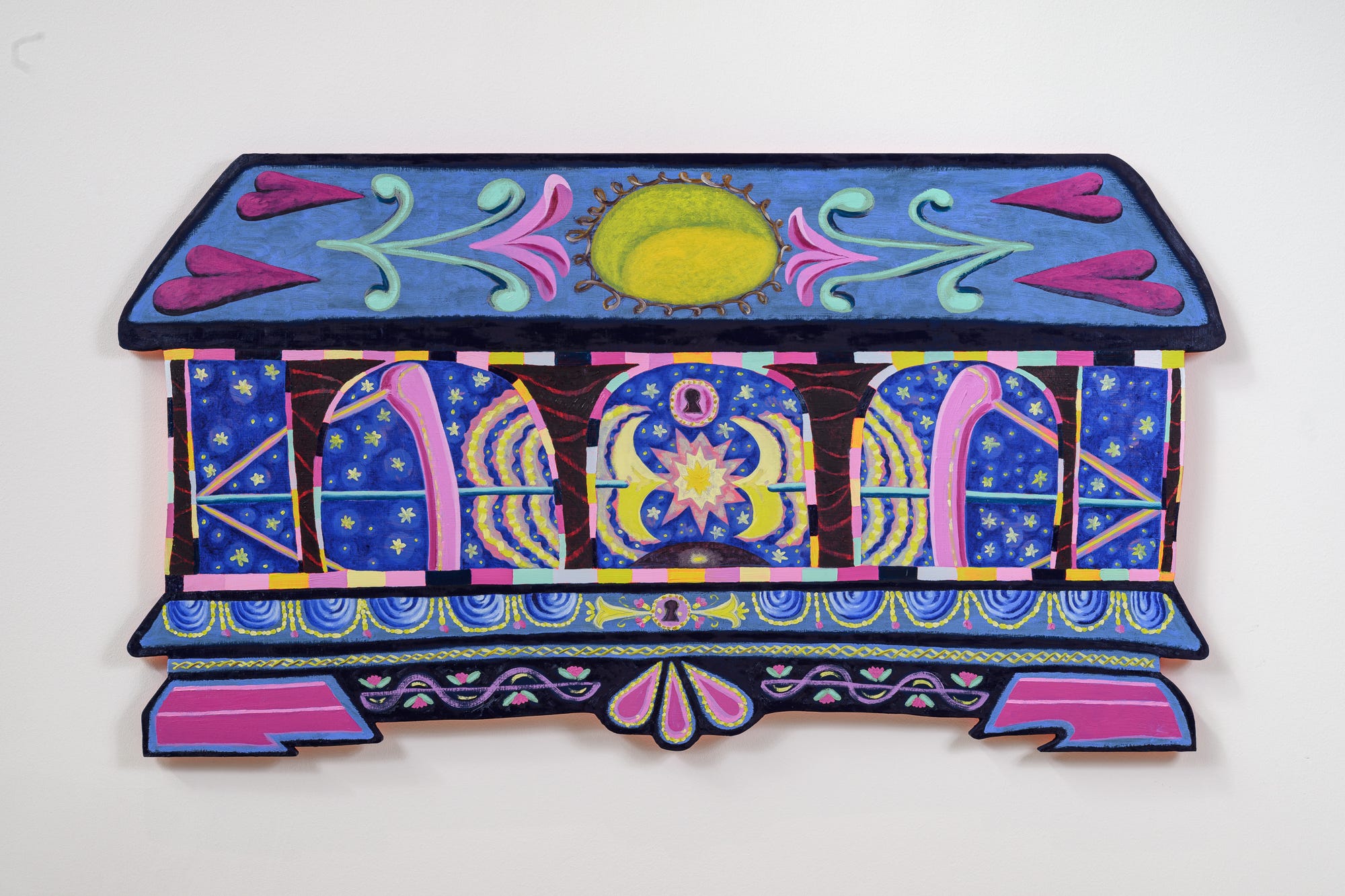
Gegenheimer takes great care in honoring her suburban Pennsylvania origins. When I lived in Los Angeles, I’d lie and say I was from Philadelphia (I’m from the suburbs). I never felt bad about this lie until I moved back to the PA suburbs and was surrounded by Gegenheimer’s paintings. I could no longer run from my own origin story. Specifically, Lighting in a Box (Hope Chest) takes me to Pennsylvania Dutch dowry chests. These historical objects, built by men, held the personal belongings of women that they’d take with them when given away in marriage. This image of a historical piece of furniture represents the transformative potential and hope of becoming a woman. A girl would fill it with her belongings—and her dreams. As problematic as the dowry chest is historically, in Gegenheimer’s painting, we see bright stars, two flowers that look like mouths about to kiss a yellow sun, or an eclipsed moon. Light radiates from within the box, as if it were a human soul or some heavenly architecture. The object feels eternal and perhaps a reclamation. The flatness of the paint transforms the wood panel into a window overlooking the cosmos, infinity, the Big Bang, or perhaps the Apocalypse.
What comes close to describing the political tone of We’ve Only Just Begun, the exhibition, is a text by Lauren Berlant titled Cruel Optimism (2011). Within Berlant’s dense book is this idea of the precarious now, ongoing, prolonged. She writes about post-WWII America and the myth of “upward mobility, job security, political and social equality, and lively, durable intimacy.” The book is about our attachments to things, ideas, people, and places that hinder us from living ‘the good life.’ Berlant argues that these attachments become obstacles rather than the path to the hope we long for. Carpenter’s life and untimely death are a mirror to Berlant’s theory. As a woman crafted and presented by the media as an American ideal, Carpenter also fell victim to the deceptiveness of this potent marketing message. The American media is full of false promises.
There’s nothing like being vomited on by the person you love most to teach you to sit with pain.
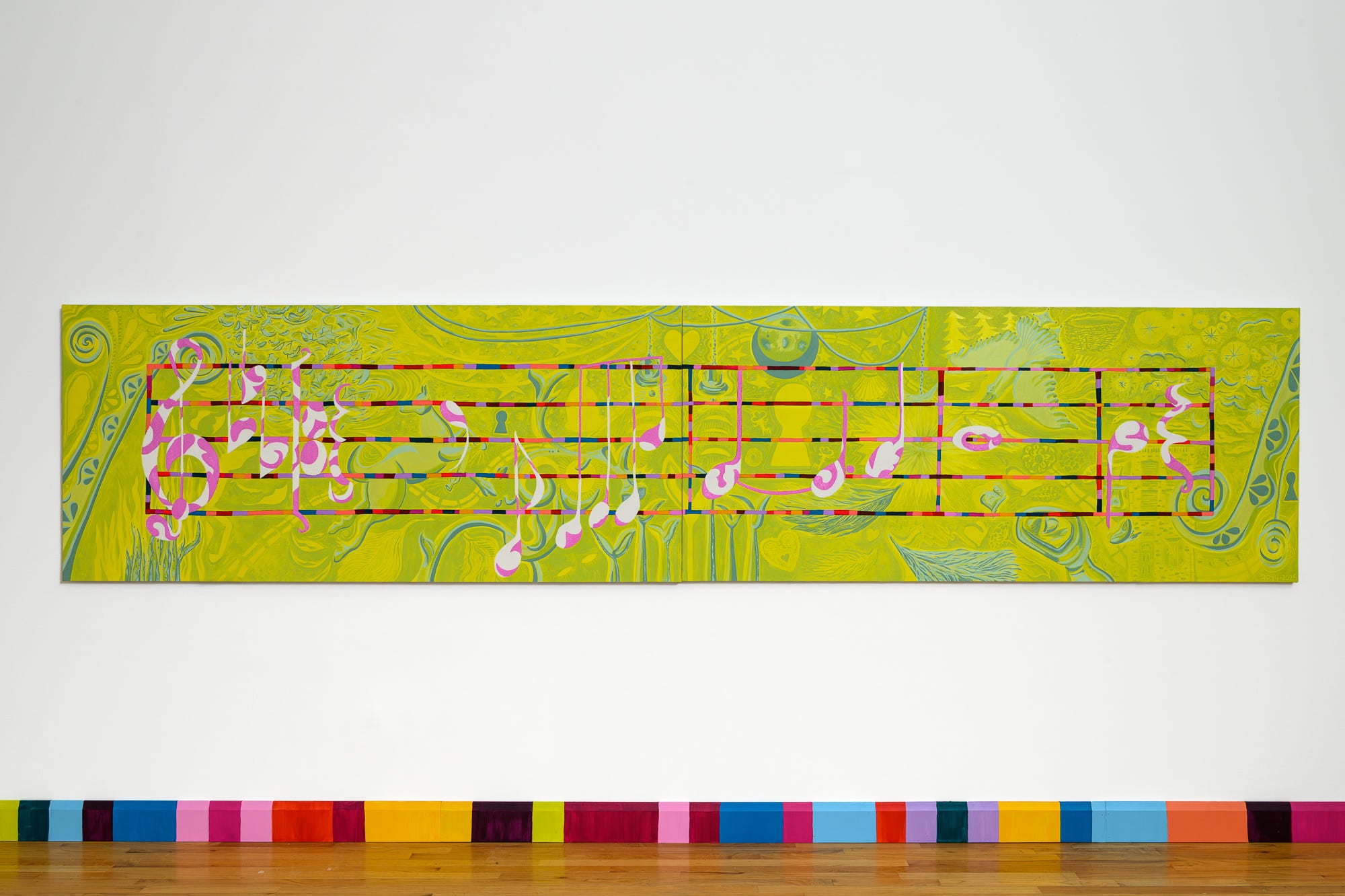
The pink and white music notes jump out of the wide, rectangular We’ve Only Just Begun—the key painting in the show. This painting acts as Gegenheimer’s conceptual map. Though the painting was made between 2023 and 2026, if you look closely, the bottom right corner has “2024-2026” painted on the canvas. This time signature marks the span of Trump’s reelection to now. The exhibition’s title, again, is an echo of how much further we must go before it’s over.
The yellow-green background subtly depicts stars, streamers, flowers, hearts, butterflies, a smiling bird, locks, keys, a row home marked in light blue. When I return to view the painting again in July, this green feels more sickly than I originally thought. America’s Semiquincentennial party has been hard for me to celebrate with any sense of hope. The yellow-green became a toxic haze, smoke, a swamp. It’s interesting to me how a happy color can also pass as a caution sign. Or a lightning strike. A deer is leaping, or fleeing, as if trying to move into the foreground where music notes are anchored. This deer is a symbol of one of two life-threatening car accidents where Gegenheimer found herself alive, but her car completely totaled. When we look at America right now, she is alive, but where is she going? I realize I can’t think my way out of heartache. Gegenheimer’s paintings are about a not-so-sappy kind of love. This kind of love is a political, revolutionary force.
I return to the pink and white in We’ve Only Just Begun, and I can’t stop seeing Philip Guston’s most controversial paintings trying to push themselves out of the music notes, or maybe they’re being squeezed. The paint is thick here, textured, rising off the canvas. Gegenheimer’s Pepto Bismol pink feels like America’s political stomachache. The multicolored music score sits between the unwell green background and the medicine pink in the foreground; all three elements vibrate with tension. Guston’s red, white, pink paintings, depicting depravity and the human propensity for violence, particularly his cartoonish klansman, haunt. Guston’s imagery confronts the viewer much more directly than Gegenheimer’s, but I can’t shake Guston’s ghosts here.
Peter Schjeldahl writes in The New Yorker in an essay titled Philip Guston and the Boundaries of Art Culture (2020), “I’ve often reflected that uses of ‘we’ in critical writing are unavoidably presumptuous, though they are rhetorically meant only to invite, or perhaps to seduce, agreement. I’ve never felt less confidence in the pronoun…” After reading Schjeldahl’s words in 2026, I wonder who “we” is in We’ve Only Just Begun. Who has only just begun? And who has already ended? “We” is such a wobbly word. Gegenheimer’s work wears a girlish costume. What looks cute on the surface is actually incredibly sophisticated. Just because something appears fragile doesn’t mean it doesn’t know violence. Only someone who’s walked through some shit can make me feel this much in their work. These are not-so-sappy-love paintings.
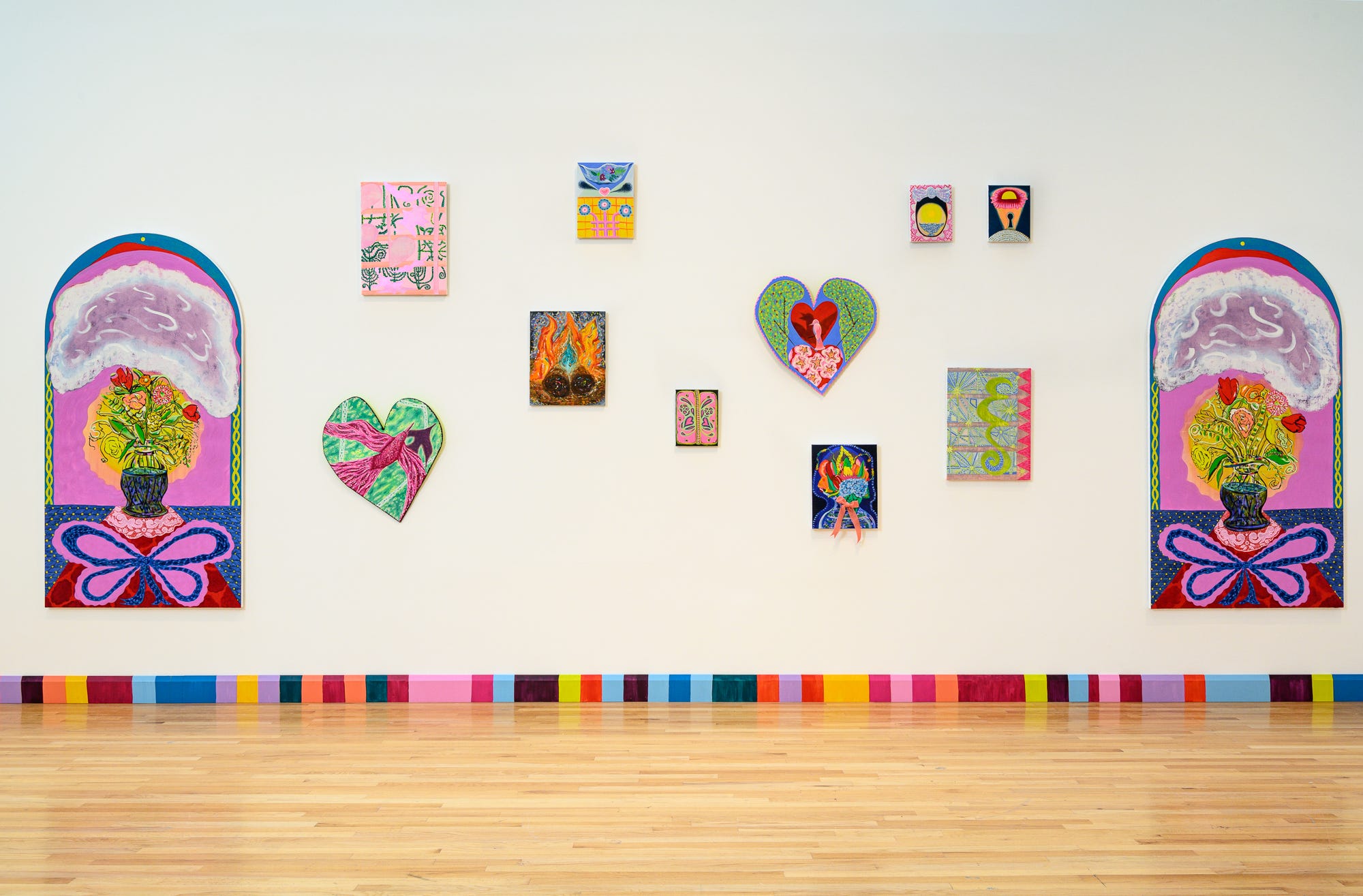
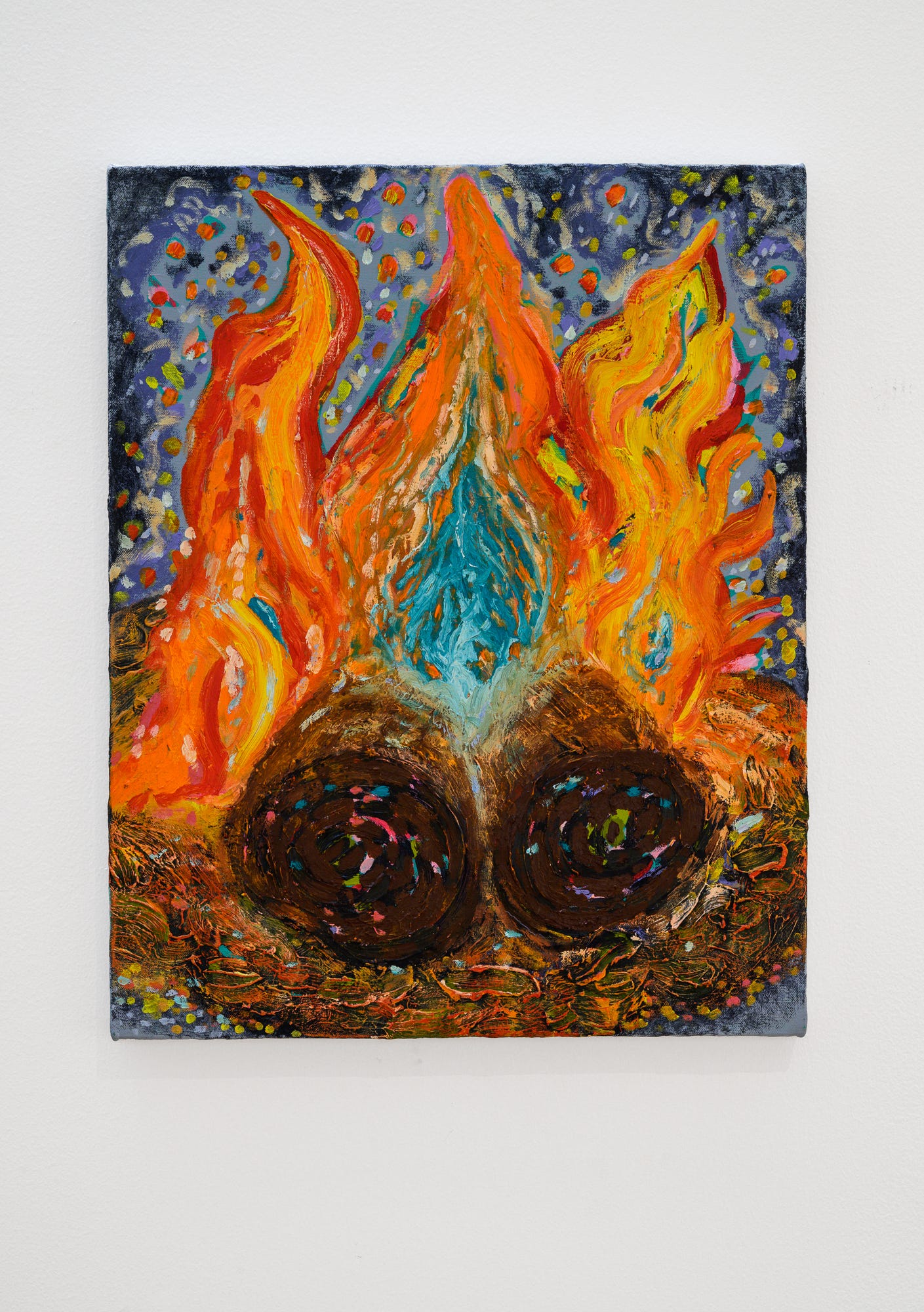
Across from the key painting on the far wall is a salon-style hanging of more paintings on canvas, panel, and linen. I see heart-shaped paintings, archways, and rectangles like portals. This wall is reminiscent of how Albert Barnes hung works in his home collection originally located in Merion, PA (also the PA suburbs). Where Barnes hung actual keys and locks on the wall next to great Impressionistic masterpieces, Gegenheimer hangs a flat painting of a keyhole titled The In-Between. Her diptych, Silver Linings (Vase Half Full), is split in half. An ambiguous white cloud hovers above both floral vases. In her paintings with birds (like Flyover (2025), Dawn Chorus (2025), and even The Edge of the Earth Ballet (2023)), each bird has a shadow, as if to suggest the dark side of ourselves we must confront and examine. Yet, her works have a gentleness and humility that is approachable and nonjudgmental. The warm, happy colors are friendly invitations. Make Your Own Luck (2021)—the first painting in this series—becomes kindling for the whole show. Multicolored speckles are sprinkled throughout; you can almost hear the wood crackle.
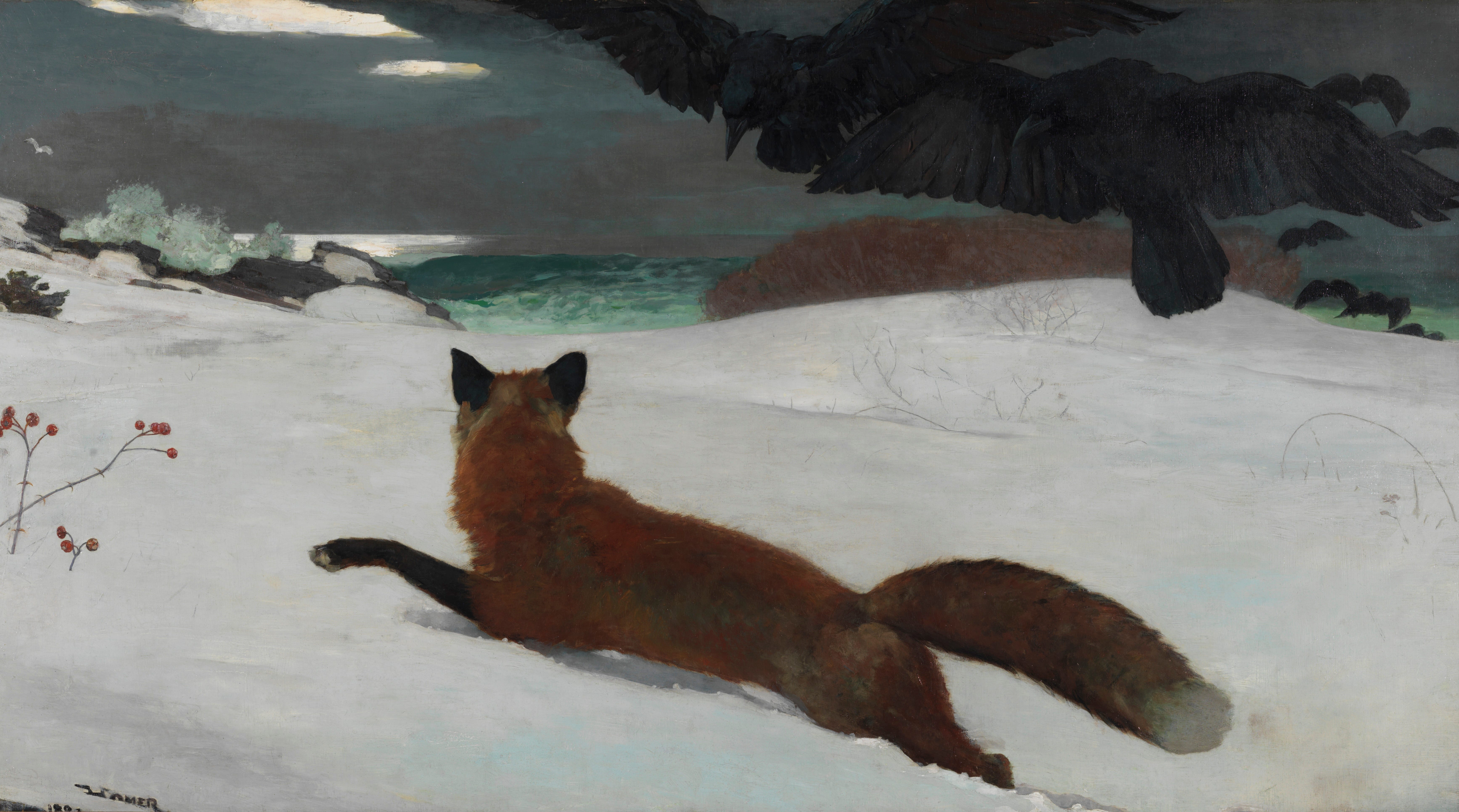
The other large work in the exhibition, Mars at Belmont Plateau, After Homer’s Fox Hunt (Wall Calendar), is a tribute to Winslow Homer’s Fox Hunt and an expansion of it into a colossal calendar. Calendars measure time, just differently than a musical score. It’s broken into two halves, like a typical calendar, or a vertical diptych. Homer’s Fox Hunt is part of PAFA’s permanent collection. In 1894, Harrison Morris purchased Fox Hunt for PAFA out of the annual exhibition, the year after Homer painted it. It was painted while Homer was living along Maine’s coast in an environmentally harsh winter climate. Homer’s fox is in crisis. Homer sat and watched the scene through his studio window. This animal of prey is seen being preyed upon by menacing crows in search of food in the dead of winter. There’s a foreboding violence afoot. The ominous crows occupy the same space in both Homer and Gegenheimer’s paintings. But Gegenheimer’s dog Mars is on a walk. Instead of Maine’s jagged water’s edge, one sees the Philadelphia skyline.
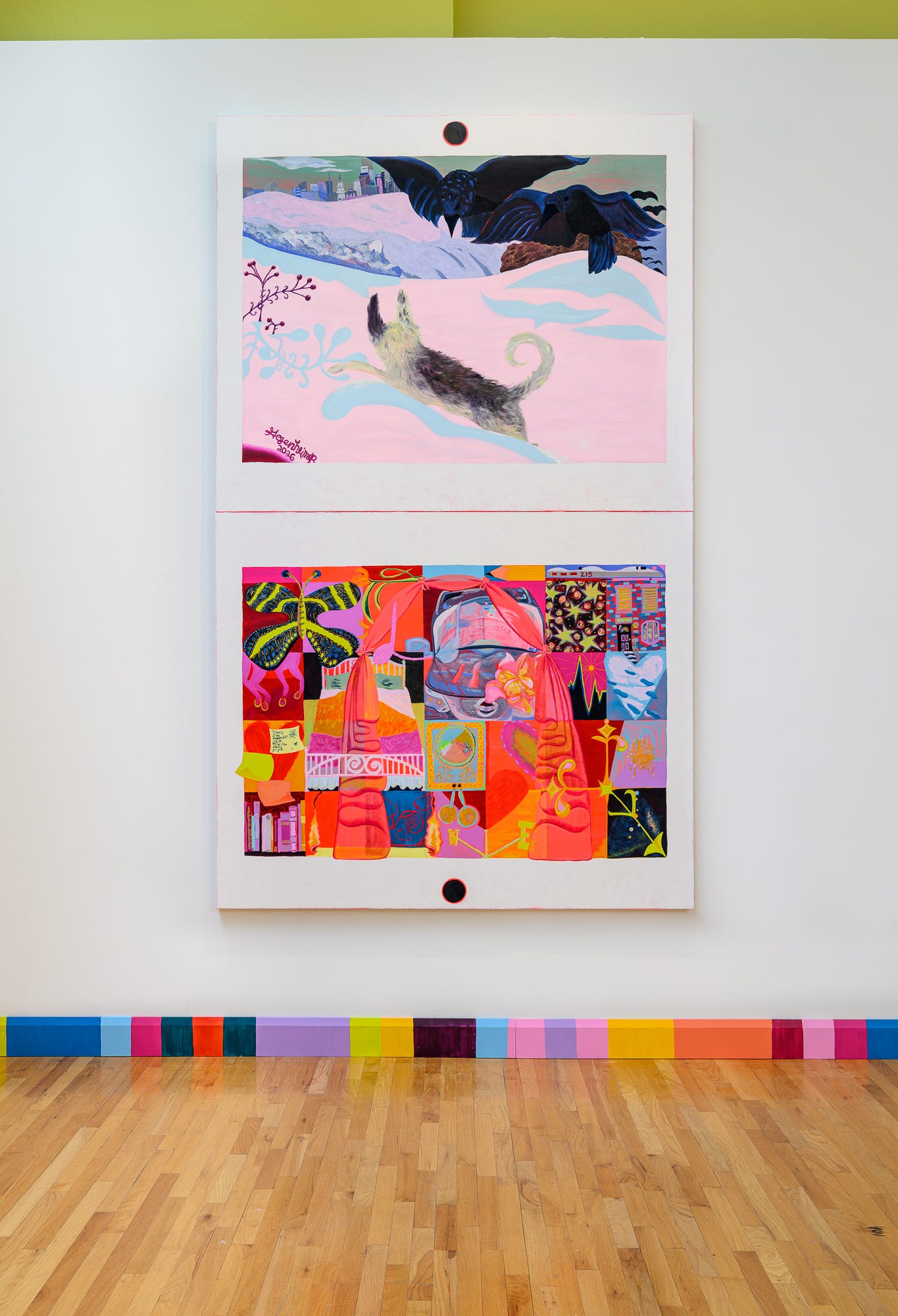
In Gegenheimer’s painting, the glass has been shattered. The dog, the crows, and the berry plant have their shadows in light blue. Like in Homer’s painting, Gegenheimer’s signature and date run parallel with the animal’s body and the crow’s wingspan. But where her snow has a reflective pink glow of a sunrise or sunset, Homer’s painting is covered in a cloudy doom and gloom. The fox stares out at the jagged cliffs; there’s nowhere for it to retreat or find shelter. Mars overlooks a city full of people desiring “the good life.” Where the fox faces death, Mars looks toward possibility.
And below is the wall calendar, the days of the week. We can assume it’s winter—perhaps February. A month known for its weariness, February represents a longing for spring, rather than marking the date of a specific crisis. Unlike the fox, Mars belongs to the artist. The calendar is filled with things. Each day is a vignette, a window into the artist’s interior world. A pink curtain reveals a car hood. There’s a list of things to get done. There’s a question of which way to go and how to spend one’s time. A shelf of books, a butterfly, a bed, and the bottom half of a horse runs free.
There’s nothing like becoming a mother for life’s shadows to haunt you. My girl becomes a mirror to my own longings and dreams. Gegenheimer’s paintings of girlhood reflect upon these longings and the mystery of the unknown.
Berlant’s cruel optimism comes close to what I feel in front of these paintings, but “cruel” isn’t quite right. For Berlant, the cruelty is that you can’t let go. But attachments are what make life feel livable even as they wear you down. If one is mindful of these ties, one is not a victim but a participant who chooses how to respond. Here we see Gegenheimer’s paintings translating what I’d call a painful optimism. Hope isn’t corny; it is a choice. Gegenheimer is self-aware of the tropes and rabbit holes of girlhood. Of American society. Of life itself. She’s faced death and survived. Yet, she somehow paints optimistically, without being detached or uninformed.
I want my daughter to have “the good life,” and I am afraid of an untimely death.
I find that I am no longer alone in my own longings and fears when surrounded by Gegenheimer’s paintings. I feel her love in them and her own longings. Like the Buddhist teaching to remain with suffering, Gegenheimer’s paintings warmly invite the viewer to do the same, but not alone. When surrounded by art, one is never alone. The works reward those who aren’t afraid to venture inward.
Emily Logan is a nomadic art writer and publicist. Since 2020, she’s been building Space On Space. Previously, she worked as a publicist at ArtCenter College of Design in Pasadena, CA. She holds a BFA in Sculpture from Tyler School of Art and an MS in Innovation Management and Entrepreneurship from Fox School of Business, Temple University.
Space On Space is a media movement started in 2020. Originally a cathartic impulse to process the times, SOS has evolved into an investigation into the connections between land, power, and art. The outlet creates content and offers PR services to help artists, designers, and businesses take up more space in the media. At the intersection of art writing and public relations, SOS interrogates the line between myth-making and the historical archive. The publication has produced print magazines and digital content covering artists from around the world. The magazine hosts parties, public programming, and poetry events. In a media landscape built for speed, SOS slows down—because depth is disruptive, and attention is power.